
You've probably noticed something frustrating while researching gifted programs: the phrase "gifted test" turns out to mean several different exams, and the two you'll hear about most are the CogAT and the NNAT. Here's the part most parents miss at first — you don't get to pick between them. Your school or district decides which one your child sits for. What you can control is how well your child walks in prepared, and that starts with knowing which test is coming.
So let's settle the CogAT vs NNAT question and clear up what actually separates the two.
What the CogAT measures
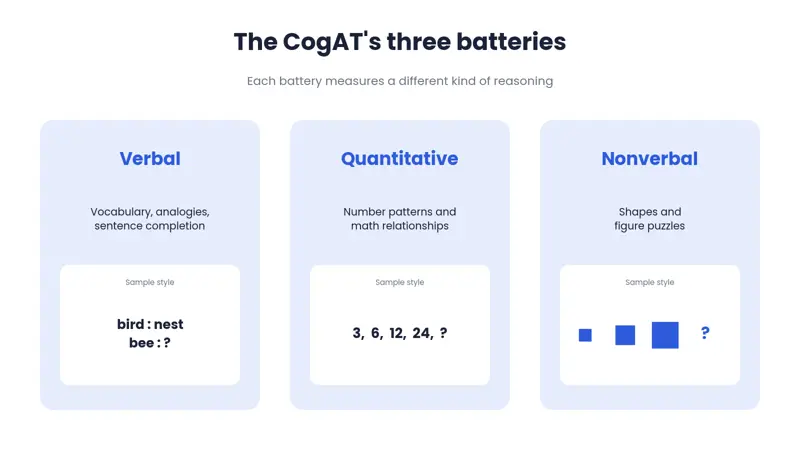
The Cognitive Abilities Test is the most widely used gifted assessment in American school districts, and it's the broader of the two. It covers three areas, called batteries: verbal (vocabulary, analogies, sentence completion), quantitative (number patterns and math relationships), and nonverbal (shapes and figure puzzles). Because it looks at all three, it gives a school a fuller picture of how a child reasons and where their strengths sit.
That breadth comes with length. Depending on grade level, the CogAT runs anywhere from about 90 minutes to a few hours, usually split into sections with breaks. Younger children take it with picture-based questions read aloud; older students read the questions themselves.
If your district uses the CogAT, a child who reads comfortably and handles word problems will feel at home in the verbal and quantitative sections. The nonverbal battery is the wildcard — it's the piece kids tend to have the least exposure to before test day.
What the NNAT measures
The Naglieri Nonverbal Ability Test takes the opposite approach. It's built entirely around visual reasoning: matrices, pattern completion, spatial puzzles, and figure analogies. There are no words and no numbers to read. A child looks at a sequence of shapes and works out what comes next.
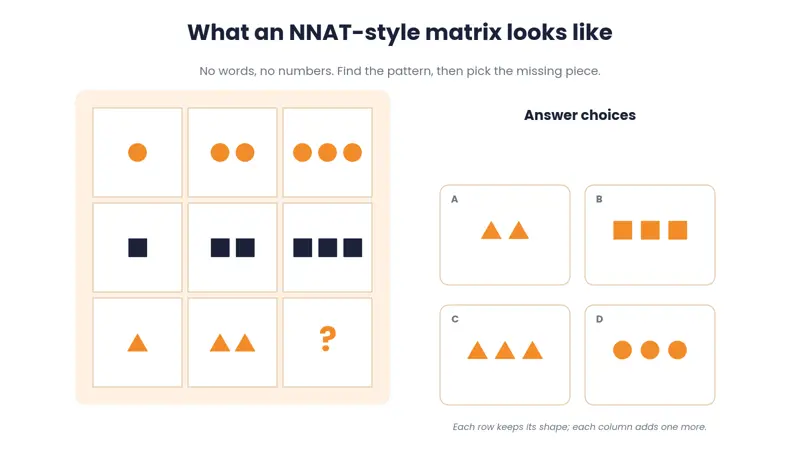
That design is deliberate. Because the NNAT doesn't depend on reading or English fluency, districts with large numbers of English language learners often choose it specifically so a language barrier doesn't hide a bright child's ability. It's also much shorter — most versions take about 30 minutes, which makes it far easier to administer to a large group in a single sitting.
The trade-off is narrower coverage. The NNAT tells a school a great deal about how a child spots patterns and thinks spatially, and very little about their verbal or mathematical reasoning.
CogAT vs NNAT: why your district picks one
The choice usually comes down to what a district is trying to see and who it's testing. A district that wants a rounded profile of every child's reasoning tends toward the CogAT. A district with a linguistically diverse student body, or one screening thousands of children at once, often leans toward the shorter, language-free NNAT. Some districts even use one test to screen and a second to confirm.
None of that is your decision — but it explains why the test your neighbor's child took two towns over may not be the one yours will take.
How to find out which test is coming
This is the one piece of homework worth doing early. There are two reliable ways to get the answer. Check your district's gifted or talented program page online, where the assessment is usually named outright. Or call your child's school office and simply ask which test they use for gifted screening. Confirm it directly rather than guessing — weighting your prep toward the wrong format is wasted effort.
Preparing for whichever one it is
Here's the reassuring part. The underlying skills these tests reward overlap more than their formats suggest. Figure matrices, pattern recognition, and analogical thinking appear on both, so practice in those areas is never wasted. Where the tests diverge is in what you emphasize.
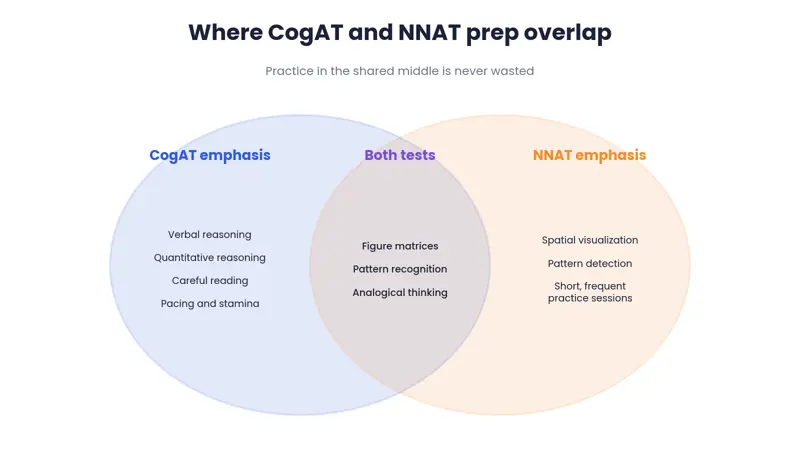
If your child is taking the CogAT, spread practice across all three batteries and give extra attention to the nonverbal section, since it's the least familiar. Work on reading carefully and on pacing too, because the test is long and stamina matters over a couple of hours.
If your child is taking the NNAT, put your energy into figure-based reasoning: matrices, spatial visualization, and pattern detection. Short, frequent practice sessions tend to work better than one long cram. The goal is to make the question types feel routine, so nothing catches your child off guard on the day.
Whichever test your district uses, the aim is the same. You want your child to know the format and feel calm with the timing, so their energy goes into the actual thinking instead of decoding what's being asked. That familiarity takes a lot of the pressure out of test day, and it tends to show up in the score.
How Gifted Prep App by Achieve Helps Your Child Prepare
Once you know whether your child will take the CogAT or NNAT, the next step is focused practice. Gifted gives children a structured way to practice, test and revise.
- 42,000+ Questions: Access a large question bank for regular practice across different gifted-test question types.
- Daily Tests: Build a consistent practice routine with regular tests.
- Filter by Difficulty: Premium users can choose questions based on difficulty and adjust practice as their child progresses.
- Attempts Insights: Review past attempts to understand practice performance.
- Bookmark Revision: Save important or challenging questions and revisit them whenever your child needs extra practice.
- Deep Revision: Go beyond simply repeating questions by revisiting previous practice and focusing on areas that need more attention.
The Goal Isn't Just More Practice
The right preparation is about helping your child recognize question patterns, reason confidently and become comfortable with the test format.
Whether the school chooses CogAT or NNAT, Gifted Prep App can help turn practice into a more structured preparation routine.