Think about the last time your child solved a puzzle. They didn't just look at one piece—they compared shapes, noticed patterns, and figured out where each piece belonged. CogAT verbal analogies work exactly the same way, just with words and logic instead of cardboard.
What Are CogAT verbal analogies?
CogAT verbal analogies are one of three question types in the CogAT Verbal Battery. Each question presents a word pair with a specific relationship, followed by a third word. The student's job is to identify a fourth word that completes the second pair in the same way.
The classic format looks like this:
Warm : Hot :: Sad : ___
Here, the relationship is degree or intensity. Warm is a milder version of Hot, so the answer should be a more intense version of Sad — which is Devastated or Miserable.
At Grade 6, the relationships are rarely this straightforward. Students encounter layered categories, abstract connections, and deliberate distractors designed to test whether they're truly reasoning or just pattern-matching on the surface.
Why CogAT Grade 6 Is a Turning Point
By Grade 6, CogAT Verbal Analogies shift in a meaningful way. Younger students often face concrete, familiar word pairs — tools and their uses, animals and their habitats. Sixth graders, however, are expected to work with:
Nuanced synonyms and antonyms — not just opposites, but degrees of meaning
Functional and structural relationships — how things relate in purpose or composition
Cause-and-effect and process-based pairs — one word leads logically to another
Category and member relationships — understanding classification hierarchies
A student who relies only on vocabulary will struggle here. The real skill being tested is relational thinking — the ability to see how two things are connected, then transfer that logic elsewhere.
Common Mistakes Students Make
One of the most frequent errors at this level is choosing an answer based on topic association rather than relationship type. For example, if the stem pair involves composer and symphony, a student might gravitate toward painter simply because both are artists. But if the relationship is creator-to-work, the correct answer must reflect that same logic — not just share a general category.
Another common pitfall is ignoring word order. The direction of the relationship matters. Seed : Tree is not the same relationship as Tree : Seed. Students need to track not just what the connection is, but which direction it flows.
How to Build the Right Approach for CogAT Verbal Battery Grade 6
Students improve most when they learn to name the relationship before looking at the answer choices. A simple habit — stating "A is to B as __ is to __" out loud or in writing — forces the brain to define the logic rather than guess by feel.
Parents can support this by making analogies part of everyday conversation. Asking questions like "How are a director and a film similar to an architect and a building?" builds the same mental muscles the CogAT tests, without a worksheet in sight.
We are providing you with 10 samples of CogAT verbal battery grade 6 questions.
For more CogAT Verbal Analogy practice questions, click here.
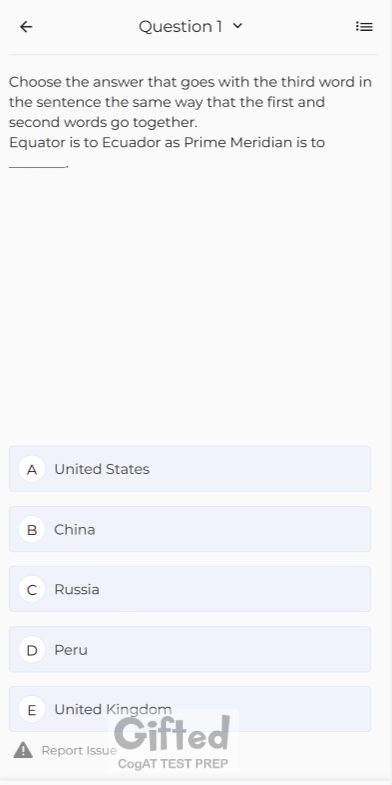
Q1.
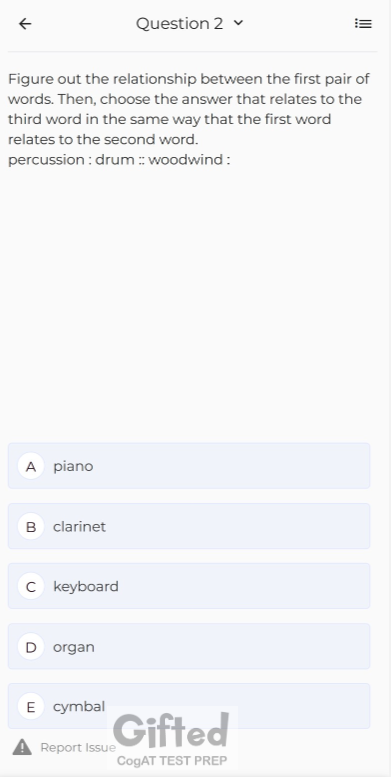
Q2.
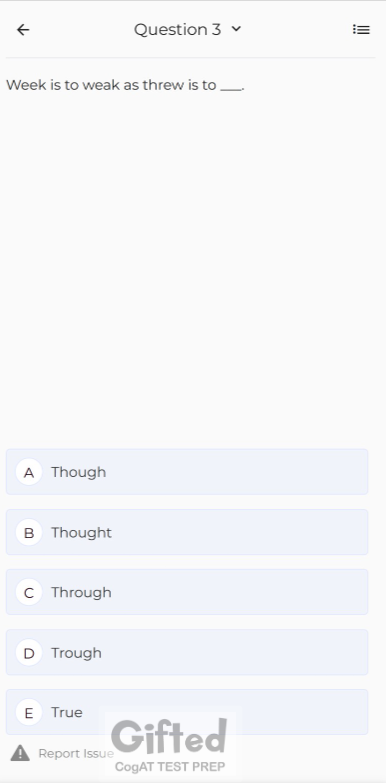
Q3.
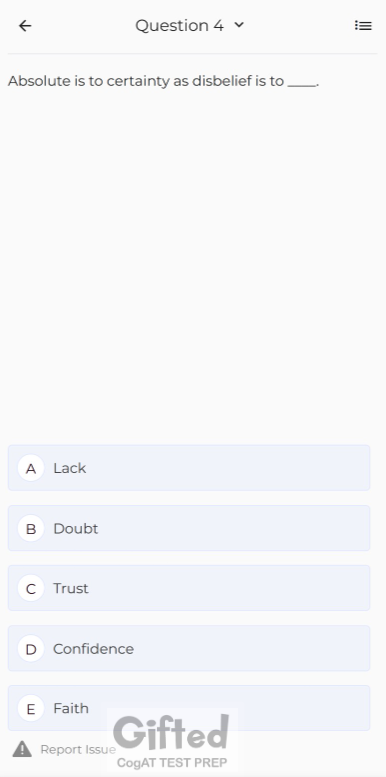
Q4.
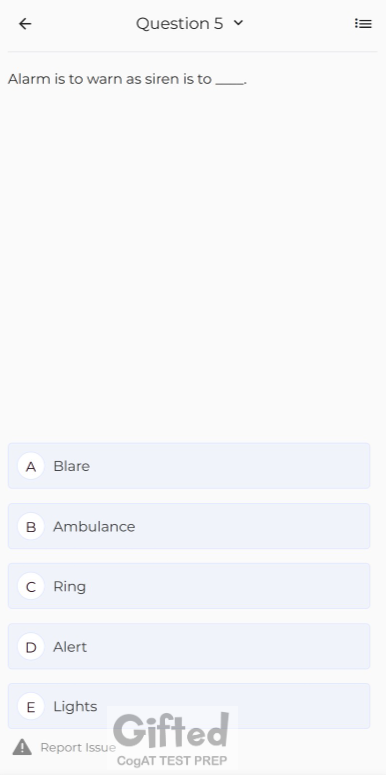
Q5.
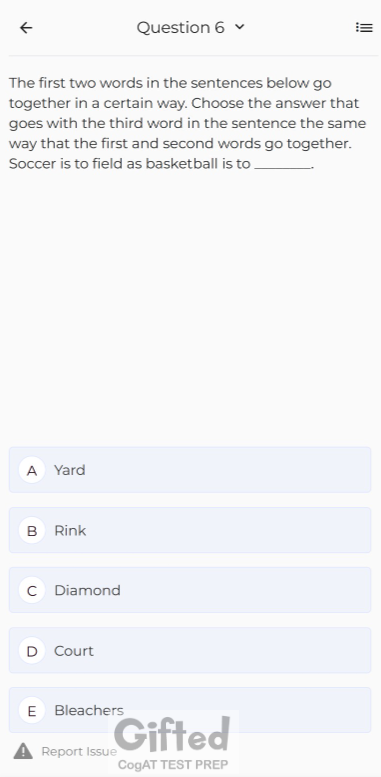
Q6.
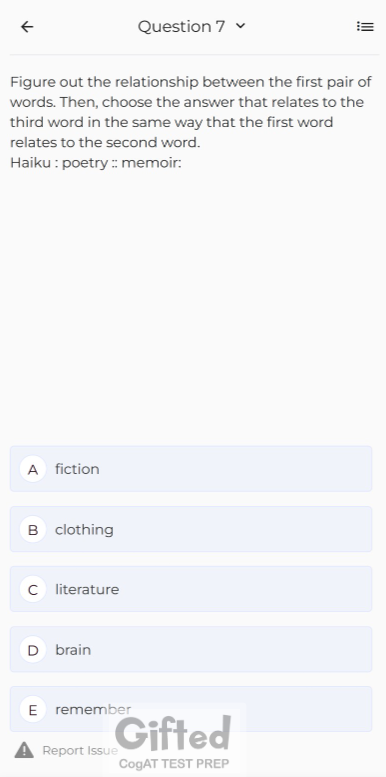
Q7.
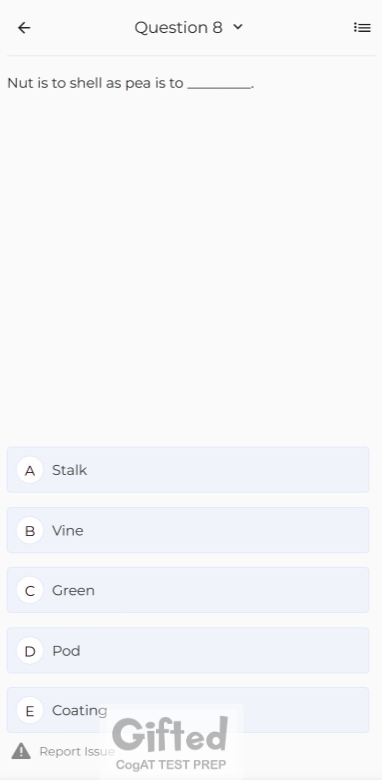
Q8.
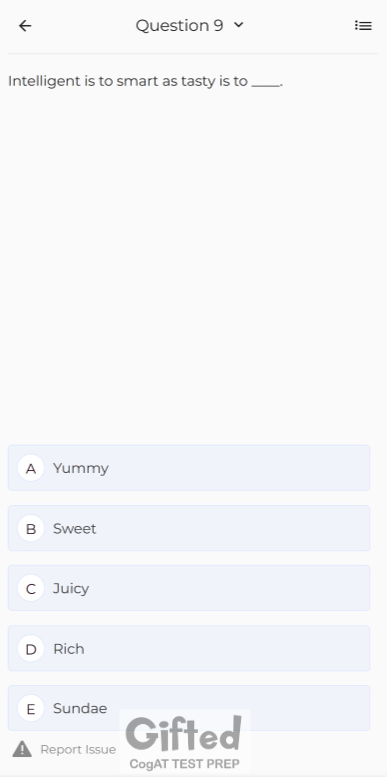
Q9.
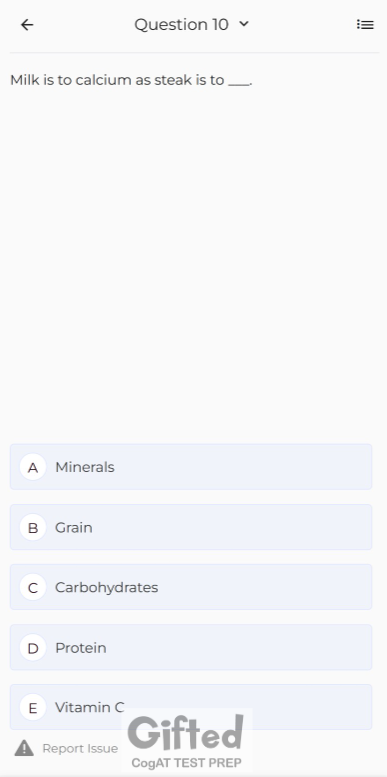
Q10.
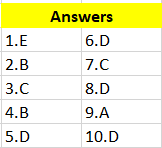
For detailed explanations and solving strategies, click here.
Build the Skill, One Question at a Time
Understanding the structure behind CogAT verbal analogies gives students a significant advantage — not just on test day, but in how they think about language and relationships in general. Gifted Prep App offers structured CogAT verbal battery grade 6 practice questions with guided explanations that teach students why an answer is correct, not just what the answer is. With consistent practice, students move from guessing to reasoning — and that shift makes all the difference.