Most math problems tell a student what to find. CogAT quantitative battery grade 6 number puzzles do something different — they present a visual equation and ask the student to figure out what makes it balance. There's no formula to recall, no procedure to follow. There's just a relationship waiting to be discovered. For many Grade 6 students, this is an entirely new way of thinking about numbers.
What Makes CogAT Number Puzzles Unique
CogAT Number Puzzles are distinct from every other question type in the CogAT Quantitative Battery. Rather than identifying a pattern across pairs or comparing quantities, students are presented with a visual number sentence — often resembling a balance scale or a structured equation — where one value is missing.
The puzzle might show that a group of numbers on one side produces a certain result, and the student must determine what value, operation, or number completes the other side to maintain that balance. It tests algebraic thinking before students have formally studied algebra.
The Core Skill Being Measured
What CogAT really assess through CogAT Number Puzzles is a student's ability to reason about mathematical equivalence. This means understanding that both sides of an equation must hold the same value — and working backwards, forwards, or sideways through the given information to find out what's missing.
This is fundamentally different from computation. A student can be excellent at arithmetic and still struggle with Number Puzzles if they haven't developed the habit of thinking about mathematical balance rather than just calculating answers.
Common Structures Students Encounter
At Grade 6, Number Puzzle formats typically involve:
Missing operation puzzles — the numbers are given but the relationship between them must be identified
Missing value puzzles — the operation is clear but one number in the equation is unknown
Balanced equation puzzles — two expressions must be evaluated and compared to determine equality
Each structure requires a slightly different approach, which is why exposure to varied puzzle formats — not just repeated practice with one type — is essential for building genuine readiness.
A Thinking Habit Worth Building Early
Students who approach Number Puzzles by first asking "what is this puzzle telling me is equal?" orient themselves correctly from the start. From there, working systematically — substituting answer choices when stuck, eliminating impossible values first — gives them a reliable method even when the puzzle feels unfamiliar.
Put your skills to the test with these questions designed to reflect actual assessment of difficulty.
For more CogAT Grade 6 Number Puzzles practice questions, click here.
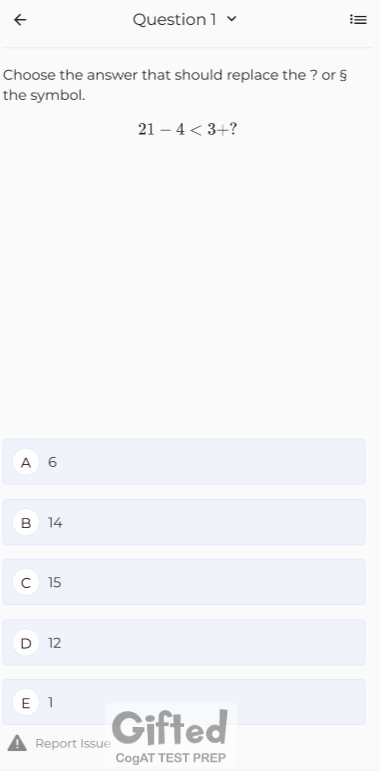
Q1.
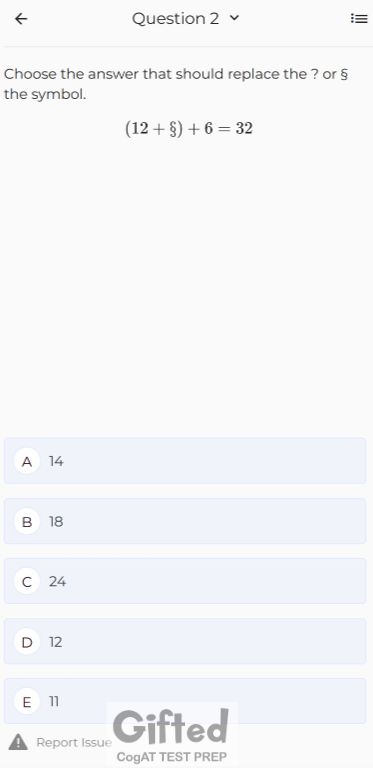
Q2.
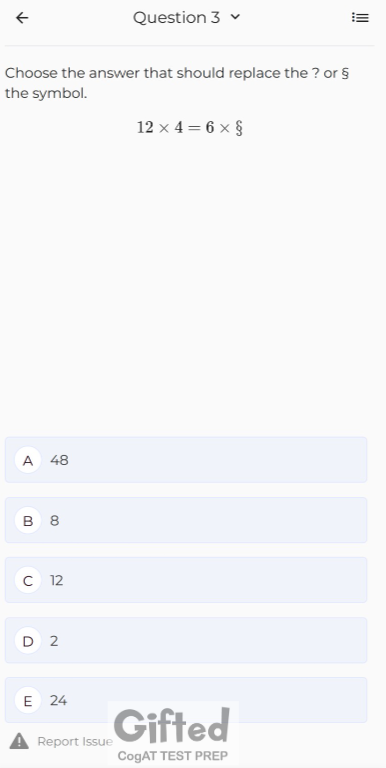
Q3.
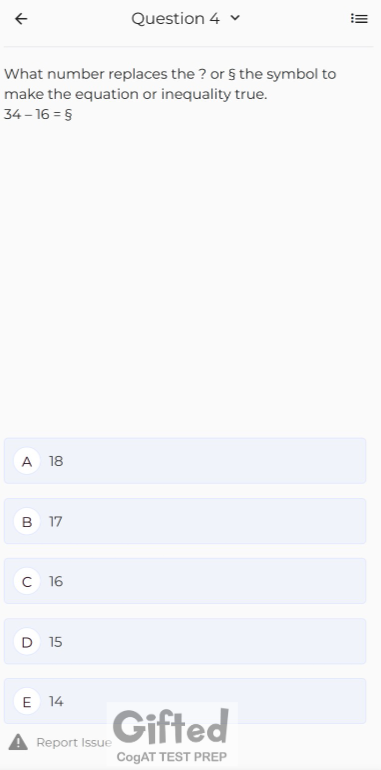
Q4.
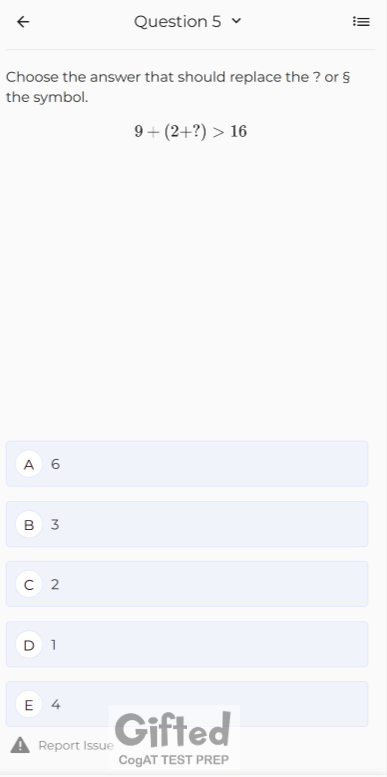
Q5.
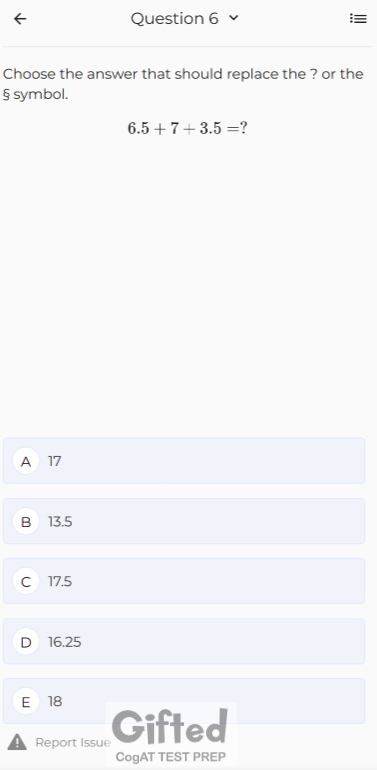
Q6.
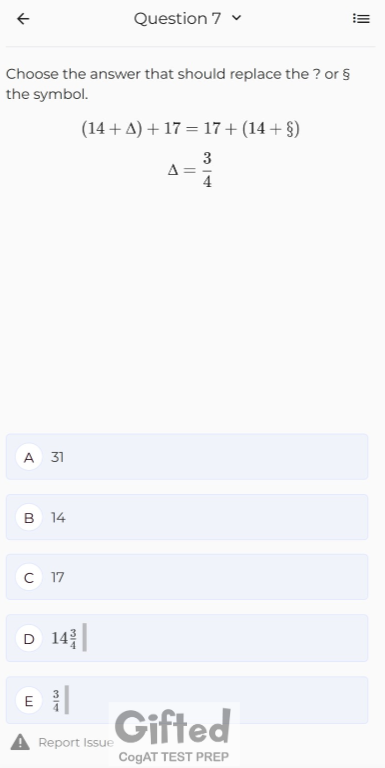
Q7.
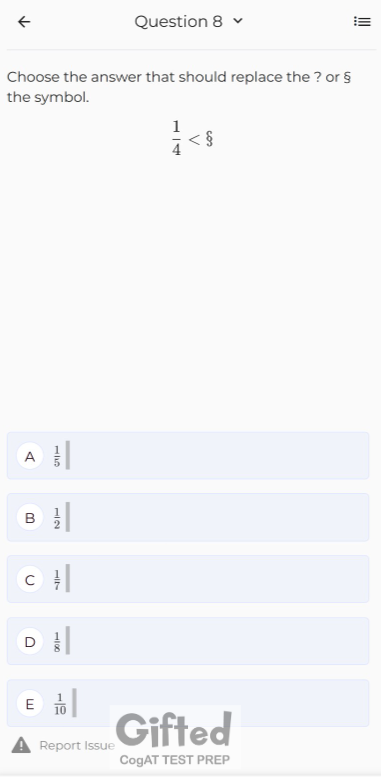
Q8.
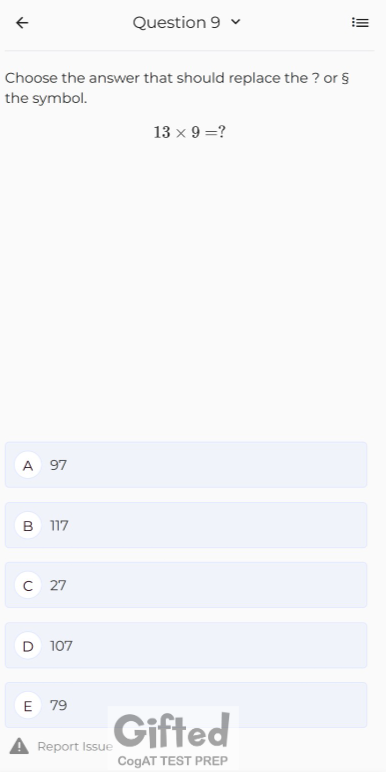
Q9.
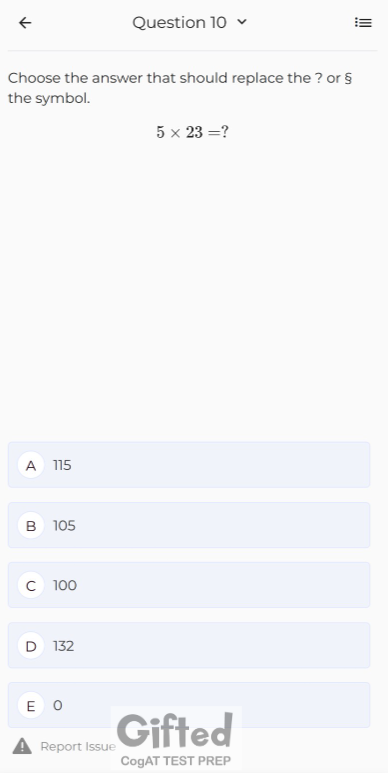
Q10.
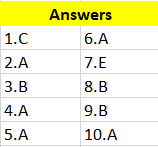
For detailed explanations and solving strategies, click here.
Make Number Puzzles a Strength, Not a Surprise .
CogAT Number Puzzles are often the least familiar question type for Grade 6 students encountering the CogAT for the first time. Gifted Prep App's Quantitative Battery practice ensures students meet this format well before test day — with structured explanations that build both the conceptual understanding and the problem-solving confidence to tackle every puzzle with clarity.