
No words. No numbers. Just shapes, patterns, and pure logic. CogAT figure matrices are one of the most distinctive question types on the CogAT — and for many Grade 6 students, they're also the most surprising. Success here has nothing to do with what a child has memorized. It has everything to do with how they think.
What Is a CogAT Figure Matrix?
A Figure Matrix presents a 3×3 grid of visual figures. The first two rows each contain three related images that follow a specific visual rule. The third row is incomplete — the bottom-right cell is missing. Students must identify which answer choice correctly completes the grid by applying the same rule that governs the rest of the matrix.
Think of it as a visual analogy. Just as Verbal Analogies test relational thinking with words, Figure Matrices test it with shapes and spatial patterns.
What Rules Are Hidden in the Grid?
At CogAT nonverbal battery grade 6, the transformations students must detect become noticeably more layered. Common patterns include:
Size progression — figures grow or shrink consistently across rows or columns
Rotation and reflection — shapes turn or flip in a predictable direction and degree
Addition and subtraction of elements — components are added, removed, or replaced as the grid moves across or downward
Shading and fill changes — patterns inside shapes shift systematically
The real challenge is that multiple rules often operate simultaneously within the same matrix. A shape might rotate and change shading at the same time. Students who only track one variable will consistently choose the wrong answer.
The Right Way to Approach the Grid
Rather than looking at the entire matrix all at once, students benefit from analyzing it directionally — first across each row, then down each column. This two-direction check helps confirm that the identified rule holds consistently throughout the grid, not just in one direction.
Parents can practice this skill at home using simple hand-drawn grids with basic shapes. Asking a child to create their own matrix — defining the rule themselves — builds the same reasoning as the CogAT tests, sometimes more effectively than solving one.
We’ve included a CogAT nonverbal battery grade 6 Figure Matrices practice test below to to reflect the format, structure, and difficulty level of the actual Gifted exam.
For more Grade 6 CogAT Figure Matrices practice questions, click here.
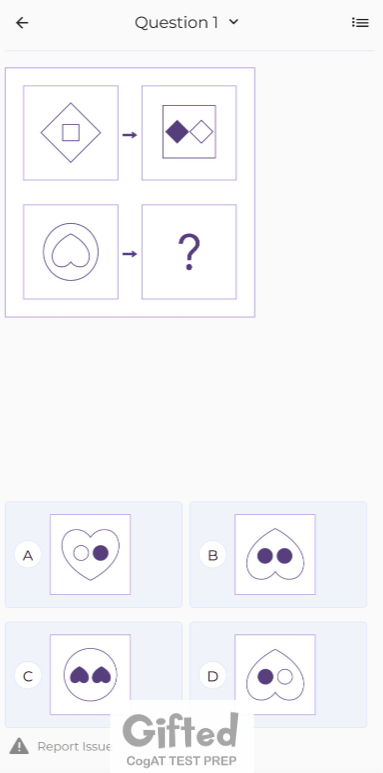
Q1.
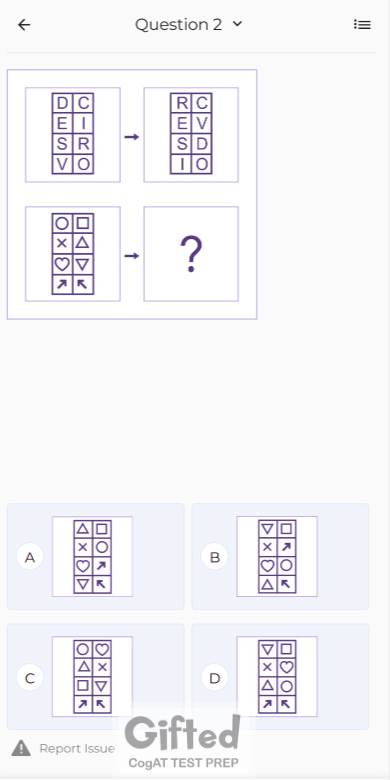
Q2.
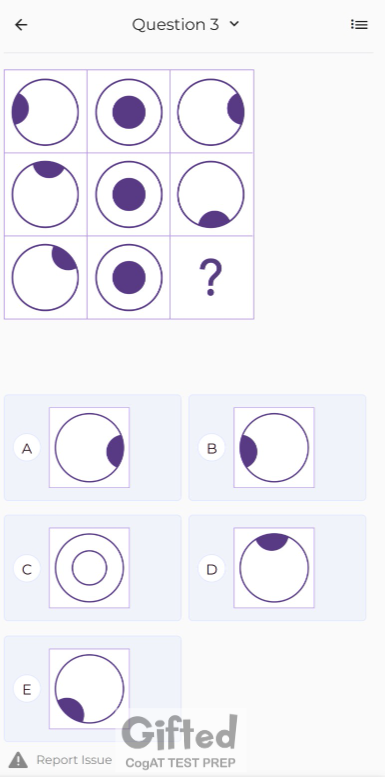
Q3.
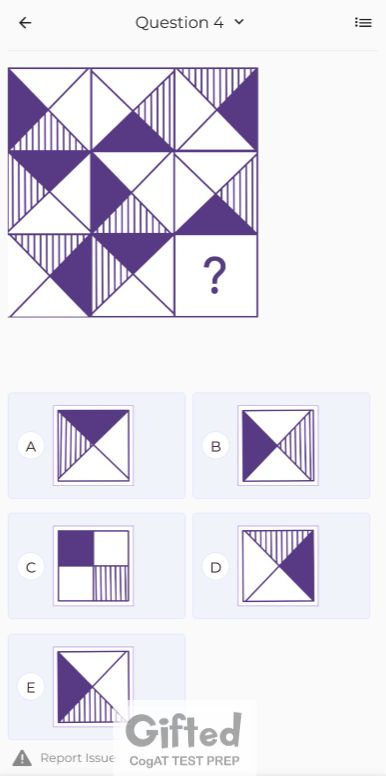
Q4.
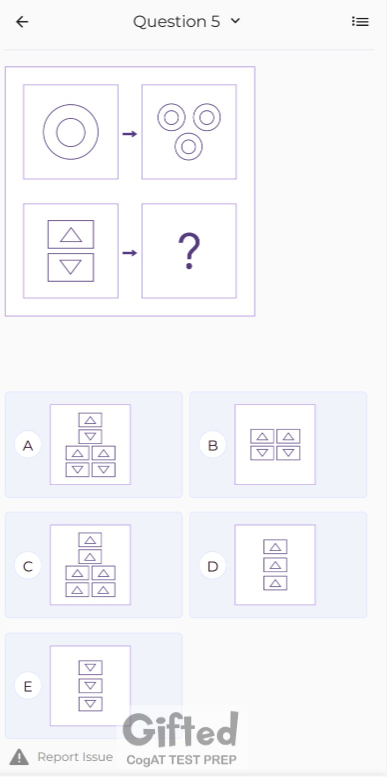
Q5.
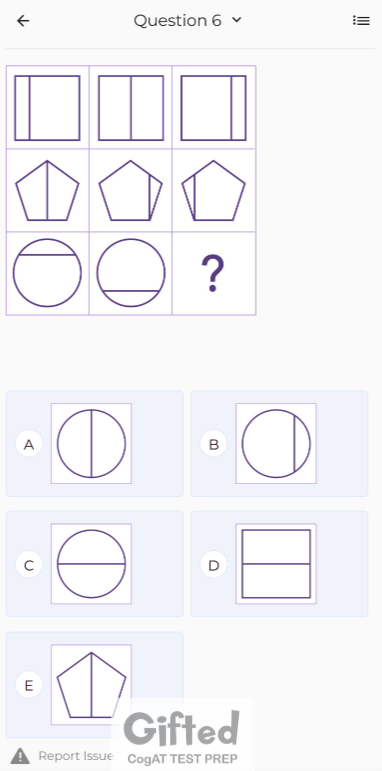
Q6.
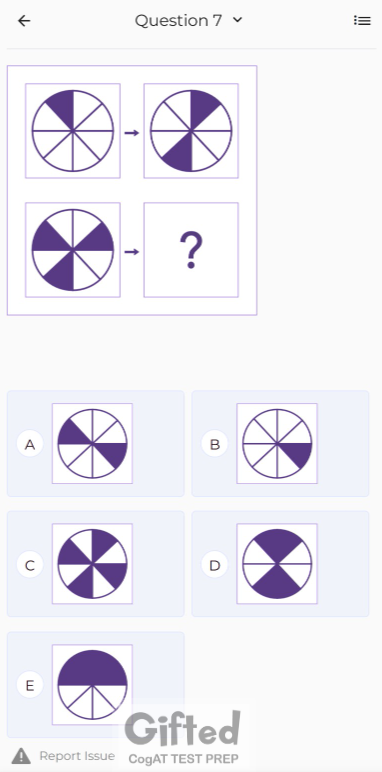
Q7.
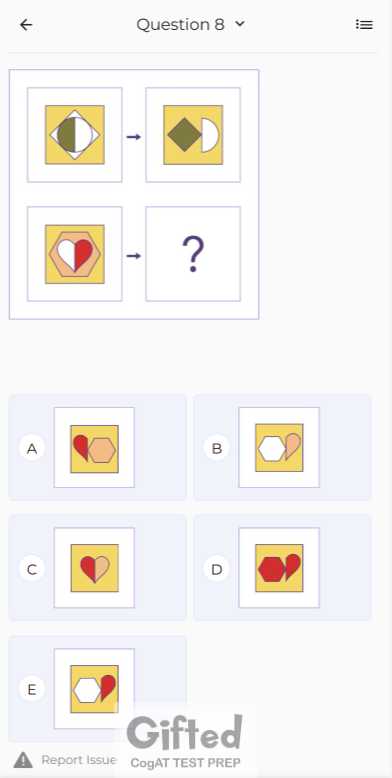
Q8.
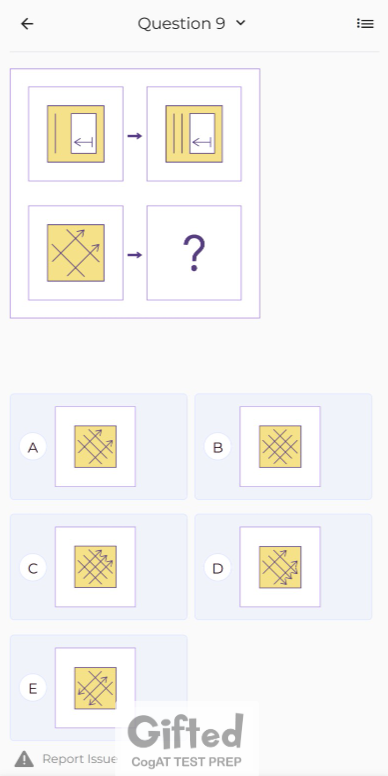
Q9.
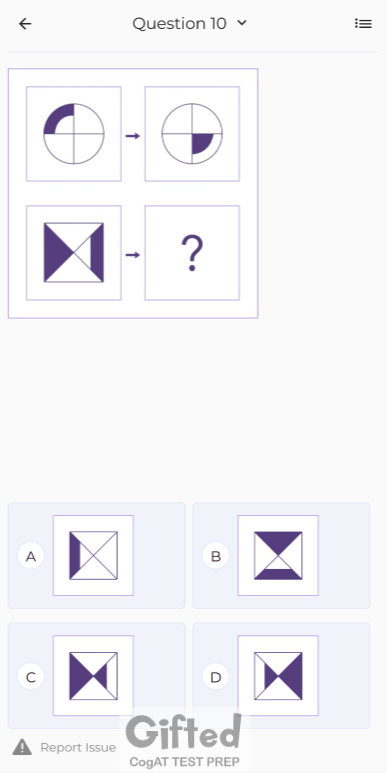
Q10.
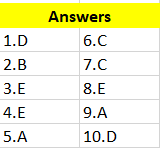
For detailed explanations and solving strategies, click here.
Develop Visual Reasoning Systematically
CogAT figure matrices reward students who observe carefully and think in patterns. Gifted Prep App offers structured CogAT nonverbal battery grade 6 practice with step-by-step explanations that teach students exactly how to decode visual rules — building the spatial reasoning skills that carry them well beyond test day.