
If your child was recently found eligible for gifted services in Miami-Dade or Broward, you probably came home with a packet full of forms and the letters "EP" on nearly every page. That document deserves a careful read. In the Florida gifted program, students are served through Exceptional Student Education (ESE), the same department that oversees special education, and the gifted Educational Plan is the written record of what the school will provide for your child.
Here's how eligibility works in both districts, what the EP must include, and where parents have a real say.
How the Florida Gifted Program Defines "Gifted"
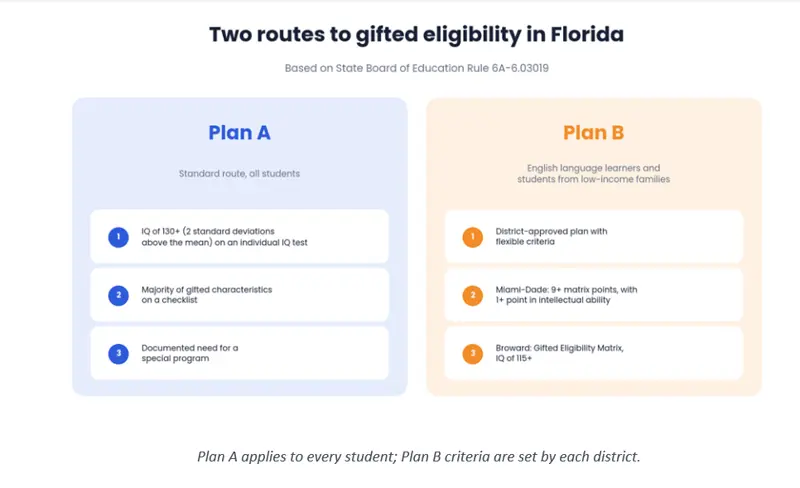
State Board of Education Rule 6A-6.03019 describes a gifted student as one who has superior intellectual development and is capable of high performance. Under the standard route, called Plan A, a student must show a need for a special program, a majority of gifted characteristics on a standard checklist, and an IQ at least two standard deviations above the mean on an individually administered intelligence test, which is 130 on most tests.
The same rule allows districts to run a state-approved Plan B for under-represented students, meaning English language learners and children from low-income families. Miami-Dade and Broward both use one.
Screening and Eligibility in Miami-Dade and Broward
Broward screens every second grader. The district's gifted page says it now uses STAR assessment results for this, after years of using the CogAT. High scorers get a full evaluation by a school psychologist. For Plan B students, Broward uses a Gifted Eligibility Matrix, and district research reports set the IQ floor at 115 instead of 130.
In Miami-Dade, the process usually starts with a referral from a teacher or parent. Its Plan B uses a points matrix that combines gifted characteristics, achievement, intellectual ability and creativity. According to the district's eligibility form, a student needs 9 or more points, including at least one point for intellectual ability.
Parents in both districts can request an evaluation at any time or submit a private psychologist's report for the district to review.
What Goes Into a Gifted Educational Plan
Rule 6A-6.030191 lists what every EP must contain:
- A statement of present levels of performance, which can cover strengths, interests, needs beyond the general curriculum, and test results.
- Goals, with benchmarks or short-term objectives.
- The specially designed instruction your child will receive.
- How progress toward the goals will be measured and reported to you.
- When services begin, and how often, where and for how long they are provided.
The EP team must include you, one of your child's regular teachers, at least one teacher of the gifted, and a district representative. You may also invite anyone with knowledge or expertise about your child. The school has to give you a copy of the EP at no cost.
Timelines Every Parent Should Know
The EP must be written within 30 calendar days after your child is found eligible, and an EP must be in effect at the start of every school year. The team has to meet to review and revise it at least every three years for students in kindergarten through grade 8, and at least every four years in grades 9 to 12. You or a teacher can request a review sooner, and the move to middle or high school is a sensible time to ask.
Making the EP Meeting Count
The rule names parents as the people who supply critical information about a child's strengths, so bring specifics. Mention the books she reads two grades ahead. Ask how each goal will be measured and how often your child will actually see a gifted-endorsed teacher. Services change with age. Younger students are often served in gifted classes or pull-out groups, while older students typically receive services through gifted, honors or advanced courses. Broward also runs Gifted Academy programs at Parkway Middle and Plantation High, which families apply to through school choice.
If you move within Florida, Rule 6A-6.0334 requires the new district to provide services comparable to your child's current EP until it adopts that plan or writes a new one. Keep a copy handy so your child's place in the Florida gifted program carries over.
How Gifted Prep App by Achieve Can Help
Before any EP is written, your child has to get through screening. Group ability tests such as the CogAT use question formats many young children have never seen, including verbal analogies, number series and figure matrices. The Gifted Prep App by Achieve gives your child 42,000+ practice questions across these question types, daily tests to build a steady routine, and bookmark and deep revision tools for revisiting the questions that caused trouble. Short, regular sessions make the format feel familiar by test day.
Conclusion
The EP is where Florida's gifted rules turn into real services for your child, so it pays to read each section closely and ask for a review whenever your child's needs change. Getting there starts with screening, and that is the part you can prepare for. Download the Gifted Prep App by Achieve today and give your child steady, focused practice with the question types that appear on gifted screening tests.