Here's a simple challenge: [3 → 9], [5 → 25], [4 → ?] Most students recognize the pattern quickly — each number is being squared. But at Grade 7, CogAT number analogies rarely stay this clean. The relationships are layered, the numbers are carefully chosen to mislead, and the time pressure is real. Recognizing the rule fast and applying it accurately is a skill that needs to be built deliberately.
What CogAT Number Analogies Test
Number Analogies in the CogAT quantitative battery grade 7 present two complete number pairs that share a mathematical relationship, followed by a third pair with the second number missing. Students must identify the rule connecting each pair and apply it to find the missing value.
What makes this different from standard math problems is the emphasis on relational thinking rather than computation. Students aren't being tested on whether they can multiply — they're being tested on whether they can identify that multiplication is the right relationship in the first place.
Common Relationship Types at Grade 7
The mathematical rules embedded in CogAT quantitative battery grade 7 span a meaningful range:
Multiplicative and divisive scaling — one number is a consistent multiple or fraction of the other
Squared and square root relationships — the connection involves exponential rather than linear change
Addition or subtraction of a derived value — the gap between numbers isn't fixed, but follows its own pattern
Combined operations — the rule involves two steps, such as multiplying and then adding a constant
Students who only look for simple addition or subtraction patterns will frequently misidentify the rule and choose a plausible but incorrect answer.
The Two-Step Verification Habit
One of the most reliable strategies at this level is to verify the identified rule against both complete pairs before applying it to the third. A rule that fits the first pair but not the second is wrong — full stop. This two-step check takes only a few seconds but eliminates a significant number of careless errors.
Students should also practice working with the relationship in both directions — understanding not just what operation produces the second number from the first, but why that specific operation is logically consistent across all pairs.
Try these Grade 7 Number Analogies questions—designed just like the ones you’ll see in real gifted assessments.
For more CogAT Grade 7 Number Analogies practice questions, click here.
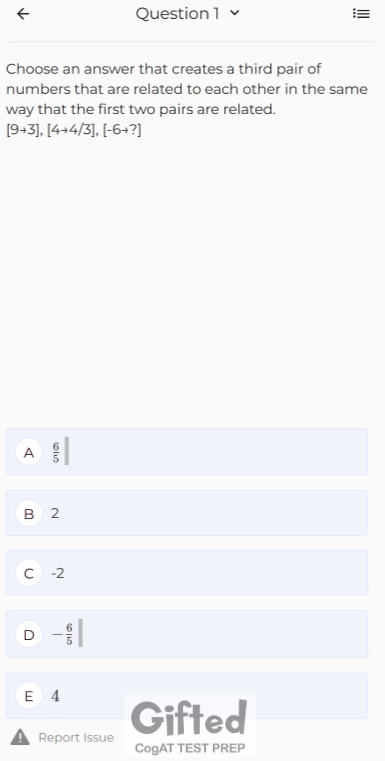
Q1.
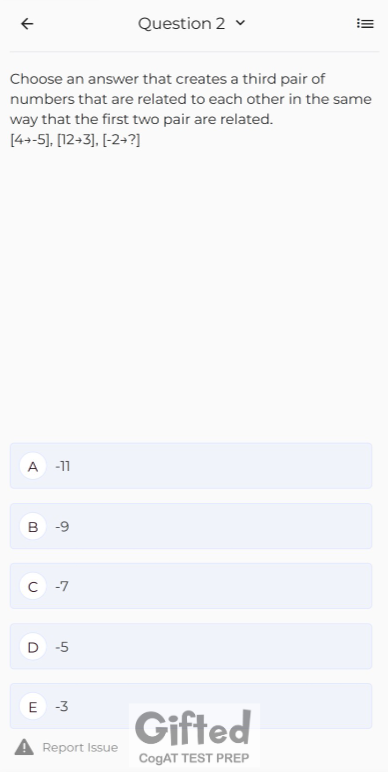
Q2.
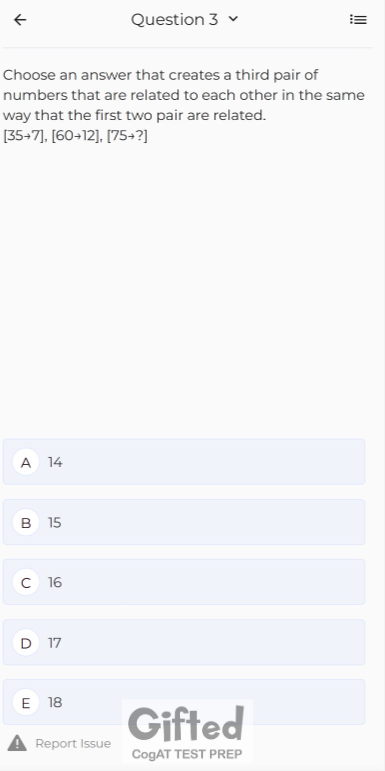
Q3.
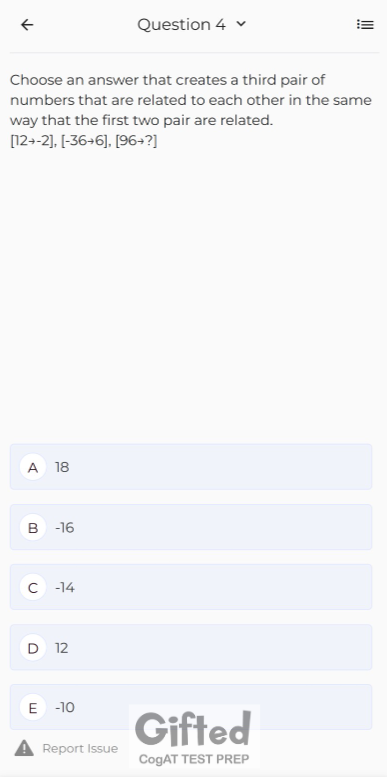
Q4.
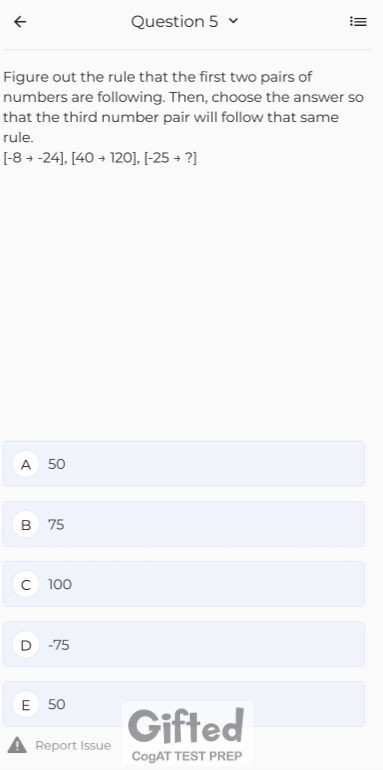
Q5.
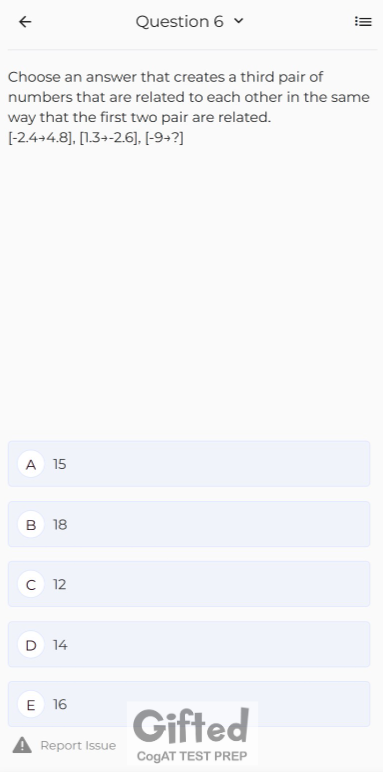
Q6.
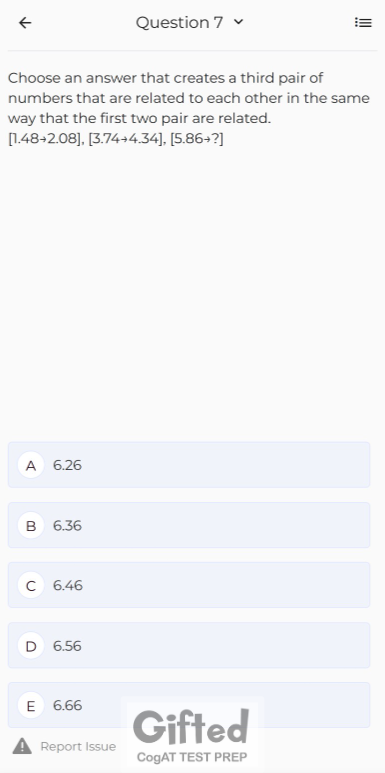
Q7.
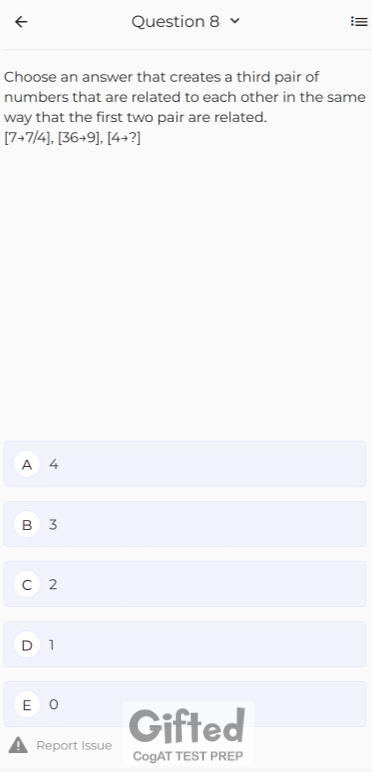
Q8.
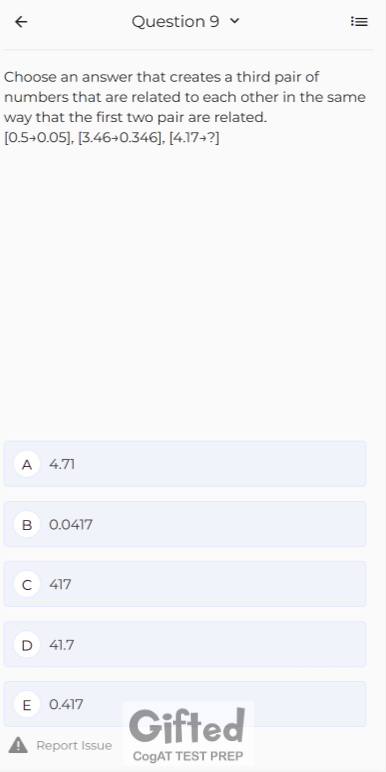
Q9.
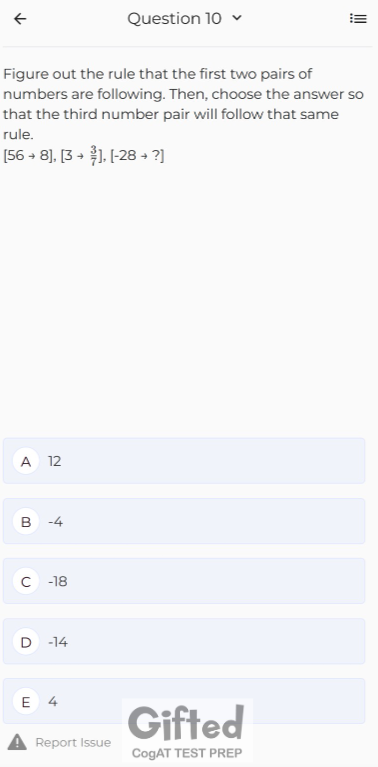
Q10.
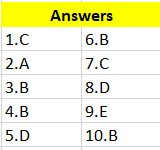
For detailed explanations and solving strategies, click here.
From Pattern Recognition to Quantitative Confidence
CogAT number analogies reward students who think relationally about mathematics rather than just procedurally. Gifted Prep App's CogAT quantitative battery grade 7 practice builds exactly this skill — with guided explanations that teach students to identify, verify, and apply numerical relationships quickly and confidently, one question at a time.