Before a child can solve complex math problems, they need to see math as a language — one built on relationships, not just calculations. CogAT number analogies on the Quantitative Battery are designed to test exactly that perspective. At Grade 6, this question type introduces students to a style of mathematical thinking that goes well beyond what's covered in a typical school curriculum.
CogAT number analogies:The Grade 6 Starting Point
Grade 6 is often the first time students encounter CogAT number analogies in a formal testing context. The concept is straightforward: two complete number pairs share a mathematical rule, and a third pair is incomplete. Students must identify the rule and find the missing number.
What matters here isn't arithmetic speed — it's the ability to look at two numbers and ask how are these connected? rather than what do I calculate? That mental shift is the foundation of quantitative reasoning.
Relationships That Appear at This Level
At CogAT quantitative battery grade 6, the rules are more accessible than at higher grades but are still designed to require genuine reasoning. Students typically encounter:
Consistent addition or subtraction — a fixed value is added or subtracted to produce the second number in each pair
Simple multiplication or division — one number is a direct multiple of the other
Doubling and halving — a specific case of multiplication that appears frequently at this level
Skip patterns — the gap between numbers follows a recognizable counting sequence
The key distinction from standard arithmetic is that students must discover the operation rather than being told which one to use. This is what makes Number Analogies a reasoning task rather than a computation task.
Where CogAT Quantitative Battery Grade 6 Students Typically Struggle
The most common difficulty at this level isn't identifying the wrong operation — it's not checking whether the identified rule works for both complete pairs. A student might notice that 4 becomes 8 by doubling, assume the rule is "multiply by 2," and apply it without verifying against the second pair. If the second pair follows a different doubling pattern that still holds, they're fine. If it doesn't, they've chosen the wrong rule entirely.
Building the habit of always checking the rule against every complete pair — before moving to the incomplete one — prevents this error almost entirely.
Think you’re ready? Try these CogAT quantitative battery grade 6 questions match real test difficulty.
For more CogAT Grade 6 Number Analogies practice questions, click here.
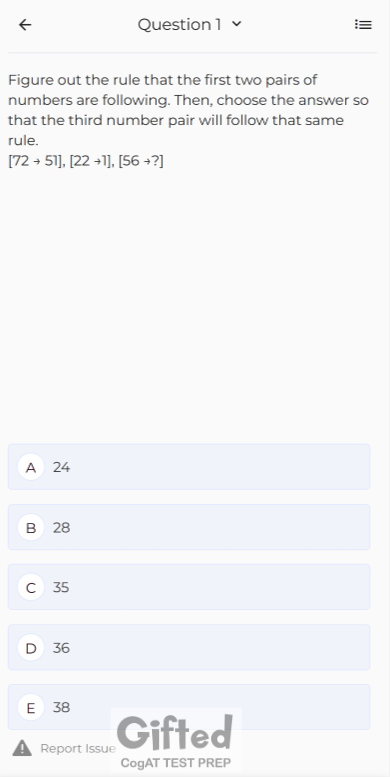
Q1.
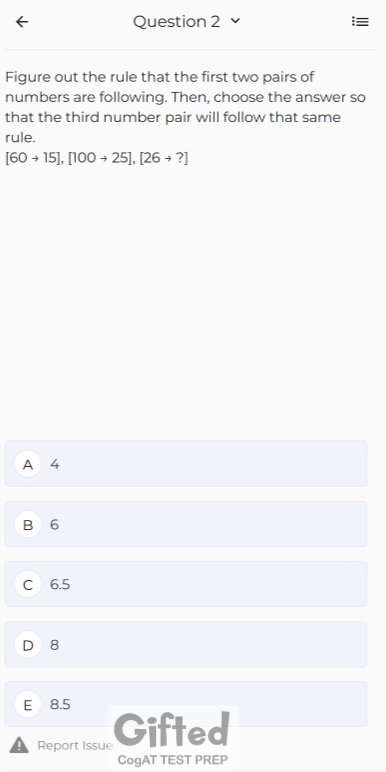
Q2.
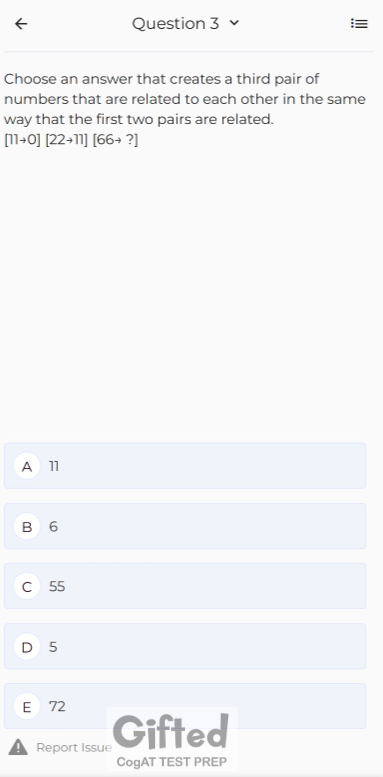
Q3.
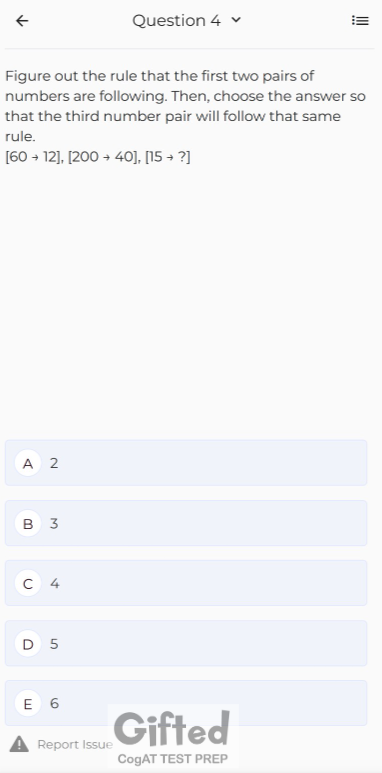
Q4.
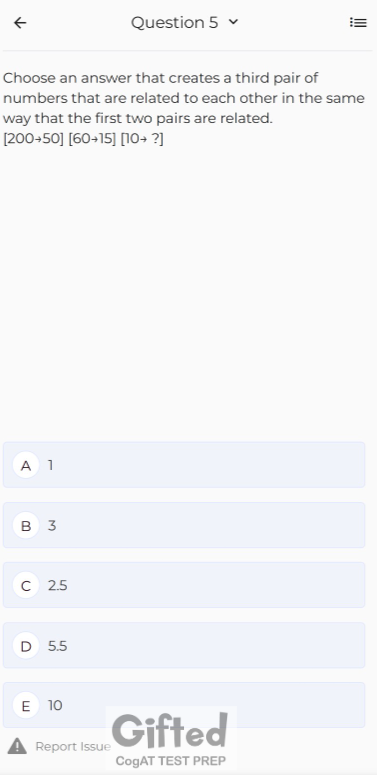
Q5.
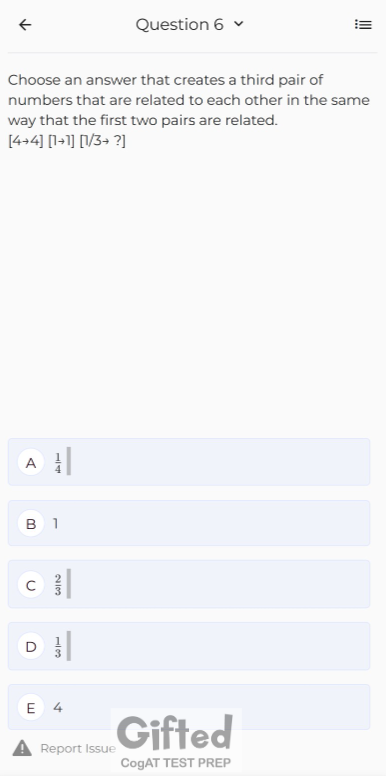
Q6.
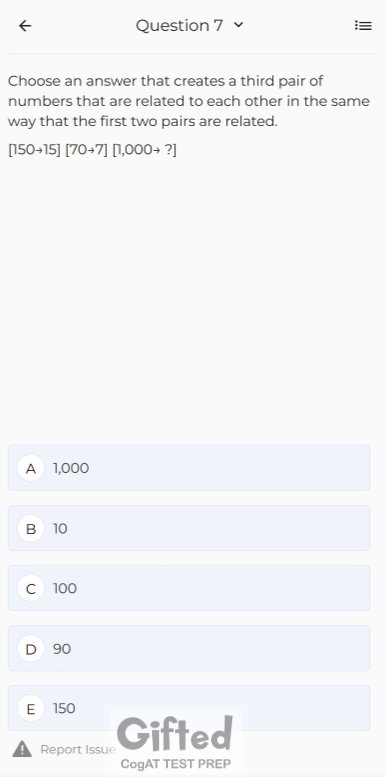
Q7.
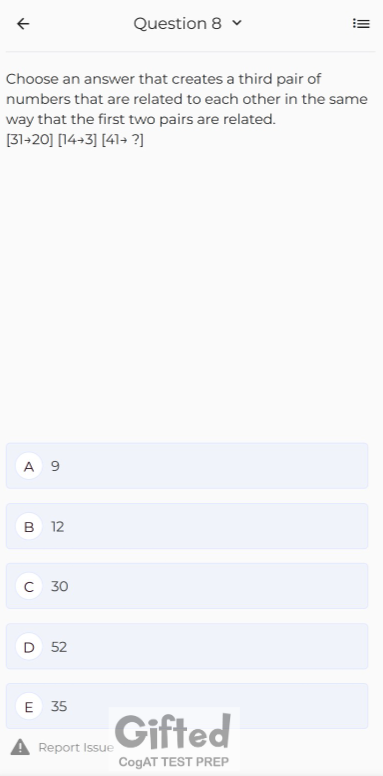
Q8.
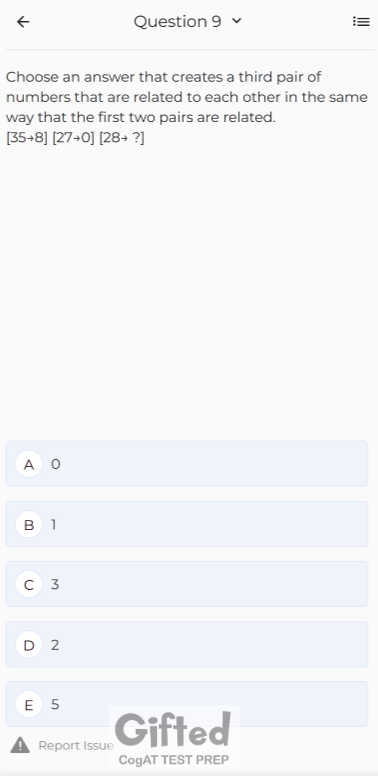
Q9.
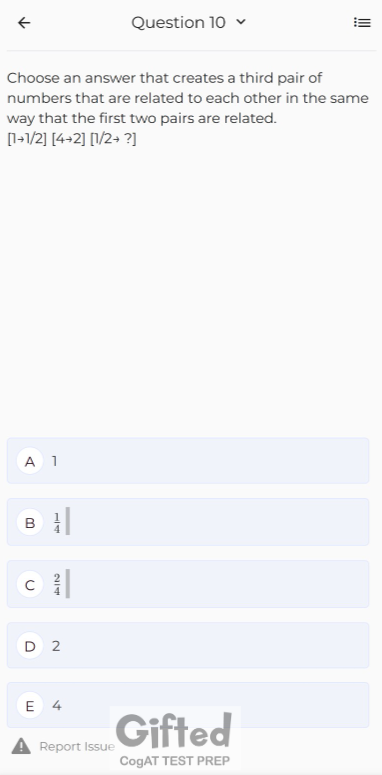
Q10.
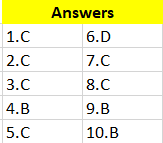
For detailed explanations and solving strategies, click here.
Starting Strong in Quantitative Reasoning
Grade 6 is the ideal time to build relational thinking in mathematics. Gifted Prep App's Quantitative Battery practice for Grade 6 introduces CogAT number analogies at the right level of challenge — with clear explanations that help students understand not just the answer, but the reasoning process behind it.