Three shapes sit side by side. They look different at first — different sizes, different fills, different orientations. But something connects them. The student's job is to figure out exactly what that something is, then find a fourth shape that belongs to the same group. Welcome to CogAT figure classification — one of the most logic-intensive question types in the CogAT Nonverbal Battery.
How CogAT Figure Classification Works
Each question presents three figures that share a specific visual property or rule. Students then select one answer from five choices that fits into the same group. Unlike Figure Matrices, there is no grid to guide the reasoning — students must independently identify the shared characteristic by comparing the original three figures carefully.
This makes CogAT nonverbal battery grade 6 a purer test of visual analysis. There are no sequence clues, no directional progression. Just three figures and the hidden rule that unites them.
CogAT nonverbal battery grade 6: What Properties Connect the Figures?
At Grade 6, the shared properties become increasingly subtle. Students may need to identify groupings based on:
Number of sides or vertices — all figures might be quadrilaterals regardless of how different they appear
Symmetry — each figure may have exactly one line of symmetry, even across varying shapes
Interior elements — all figures might contain exactly two inner shapes, regardless of outer form
Orientation relative to a baseline — figures may all point or open in the same direction despite looking visually distinct
The most common error students make is grouping by overall appearance rather than by a specific measurable property. Two shapes can look nearly identical yet belong to entirely different classification groups.
Teaching Children to Compare Systematically
The most effective approach is to compare the three given figures against each other before looking at the answer choices at all. Students should ask: what do figures one and two share? Does figure three share that same property? If yes, that's the rule. Only then should they evaluate which answer choice satisfies the same condition.
Parents can build this habit through everyday observation — grouping household objects by an unusual shared property and asking their child to identify the rule. This trains the brain to look beyond the obvious.
The following CogAT nonverbal battery grade 6 questions are carefully designed to replicate the format and rigor of gifted assessments.
For more CogAT Grade 6 Figure Classification practice questions, click here.
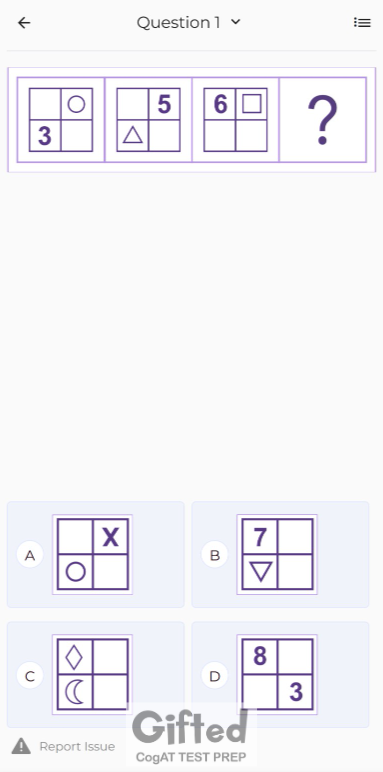
Q1.
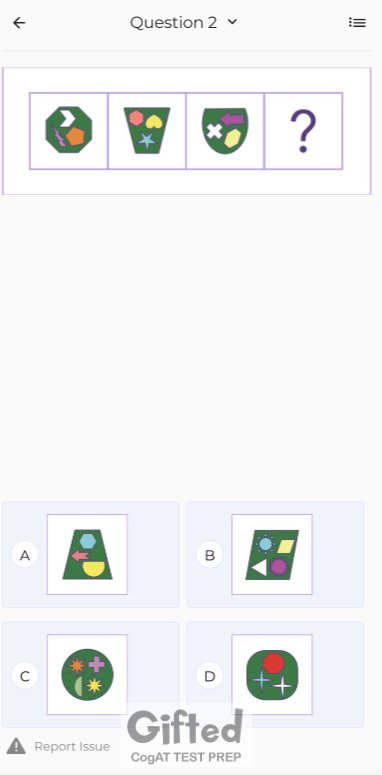
Q2.
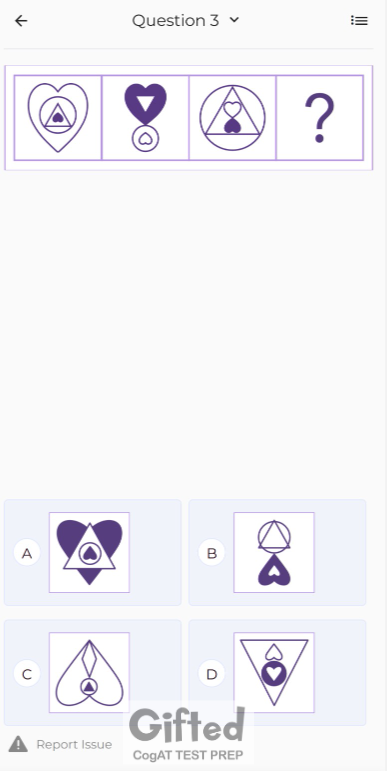
Q3.
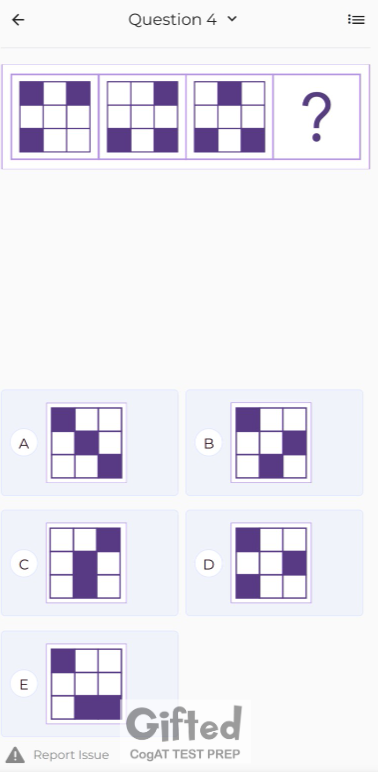
Q4.
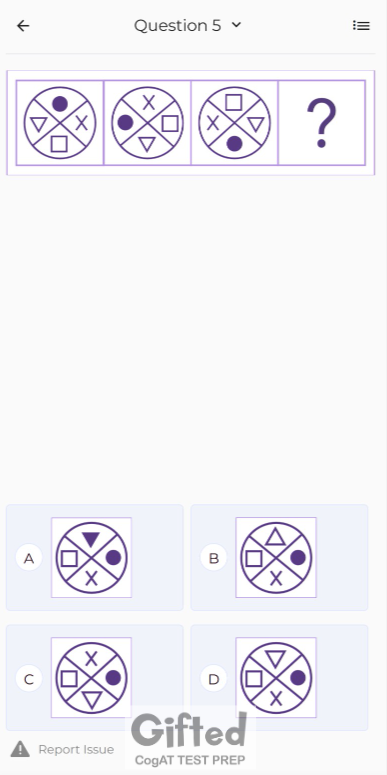
Q5.
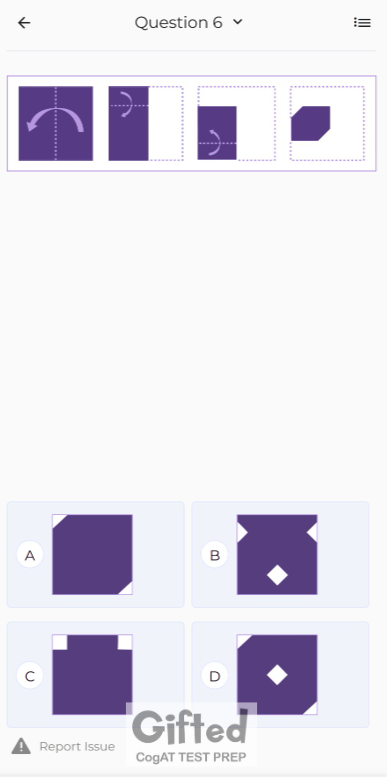
Q6.
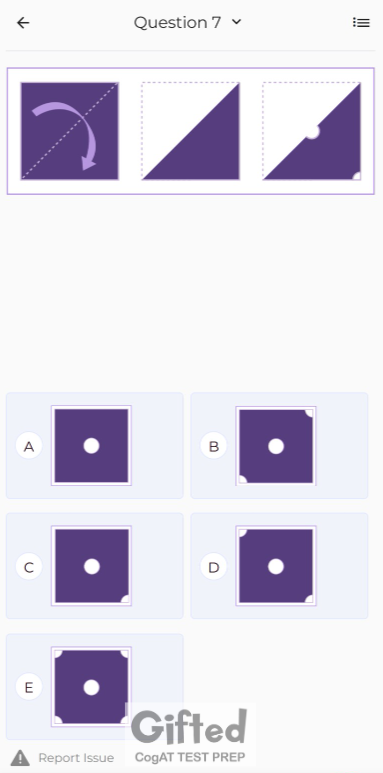
Q7.
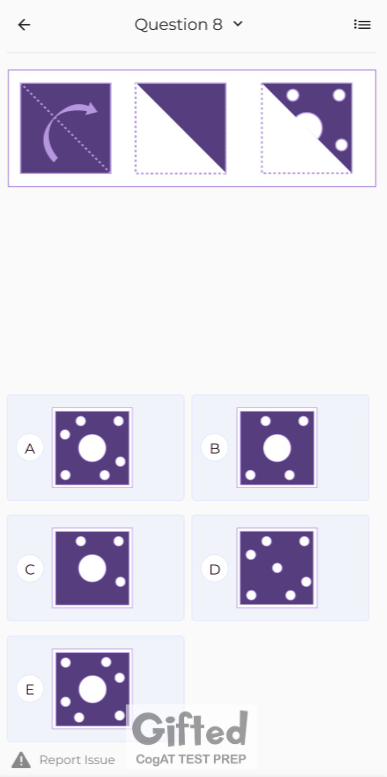
Q8.
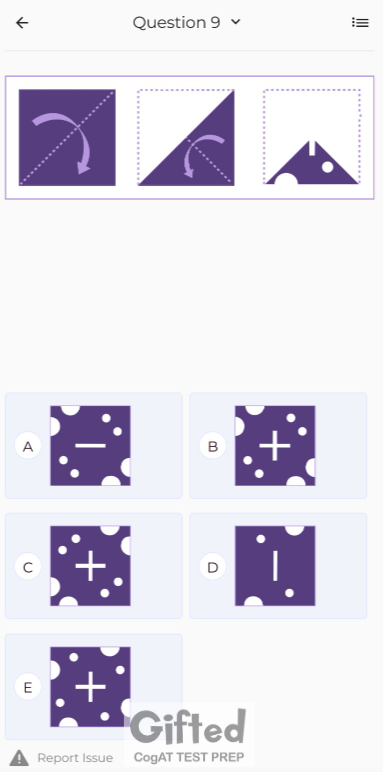
Q9.
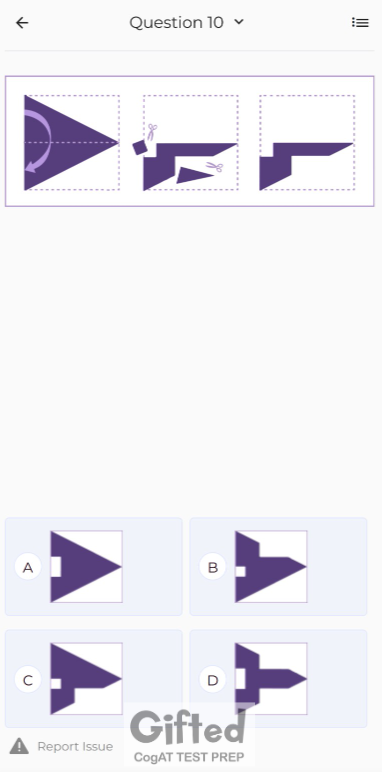
Q10.
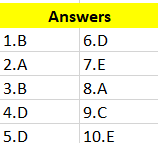
For detailed explanations and solving strategies, click here.
From Observation to Reasoning
CogAT figure classification rewards students who look carefully and think systematically. Gifted Prep App's Grade 6 Nonverbal Battery practice includes detailed visual explanations that teach students to identify hidden rules quickly and accurately — building the kind of nonverbal reasoning that gifted assessments are specifically designed to measure.